
Monday, October 19, 2015

Saturday, April 25, 2015

Tuesday, April 21, 2015
Ajrakh-Celebrating a Textile Tradition by Shelly Jyoti For Namaste Magazine by ITC Hotels publication-Jodhpur issue 2015
Ajrakh-Celebrating a Textile Tradition by Shelly Jyoti For Namaste Magazine by ITC Hotels publication-Jodhpur issue 2015
click to read :http://shellyjyoti.com/wp-content/uploads/2015/04/30-35-low.pdf

click to read :http://shellyjyoti.com/wp-content/uploads/2015/04/30-35-low.pdf
Thursday, January 22, 2015
SALT: THE GREAT MARCH- Opening & Installation shots at Azad Bhavan gallery, Indian Council of Cultural Relations,ICCR, New Delhi
Opening day reception :January 16, 2015
Chief Guest :Director General ICCR :Mr satish Mehta
guest of honour: Deputy Director General: ICCR: Mr Asthana


lamp lighting

Being felicitated by ICCR :Mr Asthana(Deputy director general ICCR) hands me a bouquets of flowers


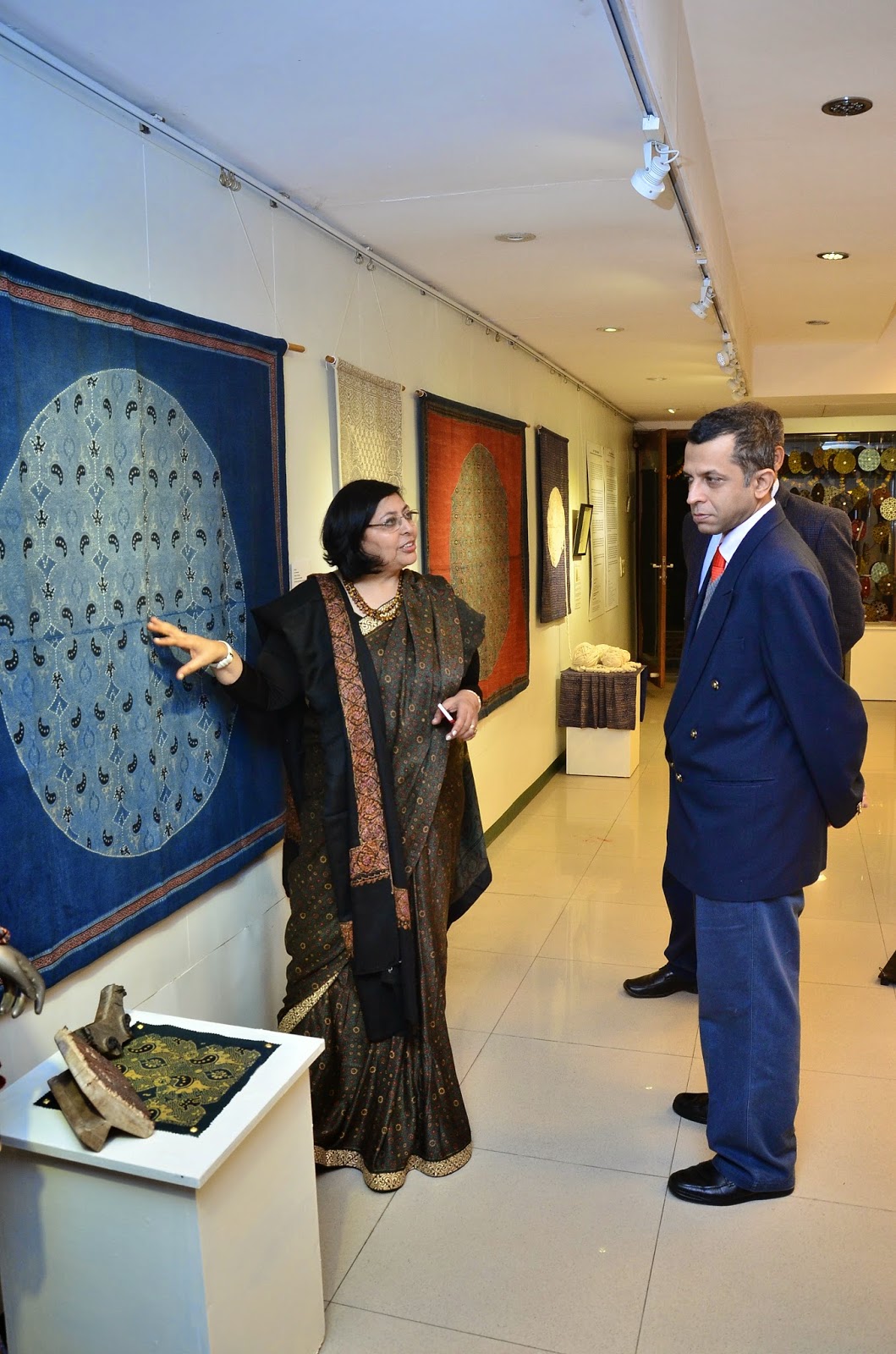
A walk with the Chief
Guest Mr Asthana (Deputy Director General of ICCR)of the evening
In 1930, a few cotton
fragments were retrieved from Al Fustat - harbor of Old Cairo ,dating from the
11th to the 14th century AD. These fragments are the earliest known printed
textiles. The simple patterns printed with small sized blocks, resist dyed in indigo
and madder, bear a striking similarity to ajrak.This particular design in the
image has resemblance to the fragments retrieved from Cairo and is known as
'Gurda kaleji 'in local language of ajrakh craftsmen .I recreated an artwork
using this block in my 'Salt March' series


Wednesday, January 14, 2015
INVITE AND CATALOG FOR SALT MARCH SHOW AT INDIAN COUNCIL OF CULTURAL RELATIONS ( ICCR ) AZAD BHAVAN ART GALLERY , NEW DELHI 16-21ST JANUARY 2015

Click to view the ICCR catalog publication
PDF version of the catalogue:Shelly Jyoti 16 to 21 Jan catalogue
Saturday, December 20, 2014
Paper presentation at XVII International Conference,Goa
XVII International Conference, Goa 21-24 December 2014 Venue: International Centre, Goa
SALT-A COLONIAL METAPHOR: RELEVANCE TODAY VERBAL, VISUAL AND NEW ART MEDIA
By Shelly JyotiDelhi based Artist, Poet and an Independent curator 
Abstract :My paper is an attempt to theorize my own artwork ‘Salt: The Great March 2013-14’ series I& II- A visual Art project. The Salt March series explore salt as a symbol of non-violence. The project is inspired by the Gandhi’s theory of satyagrah- a challenge to ones own truth with stress on self-purification, self-examination and self-assessment. Satyagrah stimulates our conscience and soul searching for the upliftment of all (sarvodaya). The “Salt” series explore khadi as a contemporary social movement visualized through art and traditional craft traditions and processes, seeking out the possibilities of bringing the khadi spirit into our daily lives. If by spinning, weaving and wearing khadi, can the commitment to individual action bring about a sense of pride in our nation in the 21st century? Can such an action bring about nationalistic feeling and significant changes in our society? The “Salt” series is a continuation of my earlier series, ‘Indigo Narratives (2008-14) that were inspired by an anti-colonial, nonviolence movement that took place in 1917-18 and also Gandhi’s first non-violence protest ‘champaran’ movement for indigo farmers in India. The works feature site-specific khadi fabric installations including clothing, 40 artworks utilizing Ajarkh textile traditions on khadi fabric and spoken poetry video film. To draw from ‘Parapolitics: Toward the City of Man’, can modern societies become genuine moral communities? According to Gandhi, they can. Gandhi’s vision of a Sarvodayan society is embryonic, but nonetheless engaging and stimulating explaining swadharma for individuals defining traditions and duty clearly. These works have been exhibited at IGNCA (Indira Gandhi National Centre for Arts) New Delhi (Sept-Oct 2013):India International Centre, New Delhi (September 2014): The Museum Dakshin Chitra, Chennai (Oct -Nov2014) Lectures of the above at IGNCA New Delhi , Lalit kala Academy , Chennai, Apparao Galleries Chennai, New Delhi 2013-14 Scheduled venues: Baroda (2015): Gandhi memorial Centre Washington Dc 2015.
click here :https://www.youtube.com/watch?v=WXl8bgjmA7Y
www.shellyjyoti.com
Saturday, November 1, 2014
Subscribe to:
Posts (Atom)